On the App Store and Google Play
One swing.
One fix.
At a time.
Film one swing. Albie tells you the single thing to work on next, out loud, before you hit the next one.


How it works
Three steps, then back to swinging.
- Stand your phone up a few steps away, facing you. A tripod, a bag, a fence post: anything that holds it at about hip height and does not move.
- Walk out and take your stance. Albie watches the camera and talks you into the shot: step to your left, a step closer. When you are set and still, it counts you down and starts filming on its own. Or import a swing you already filmed.
- Hear your one fix. Albie measures the swing, picks the thing holding it back, and says it out loud while you are still holding the club.
Hands-free
It tells you where to stand.
The hardest part of filming your own swing is that you cannot see the screen.
Albie solves it by talking. Walk out to the ball and it watches the camera for you: step to your left. Take a step back. The moment you are framed head to feet, with room for the club at the top, it says so, counts down from three, and records.
Then it keeps going. Your fix is read out while you are still standing over the ball, and when you settle into the next swing, the countdown starts again. A whole bucket of balls, and the only time you touched the phone was to prop it up. Now and then it asks whether the fix matched what you felt. Just say yes or no.
What Albie spots
Seven things that change where the ball goes.
Albie follows your body through the whole swing, frame by frame, and measures seven faults against the same cutoffs every time. The same swing always gives the same answer.
- Hips sliding sideways going back, instead of turning
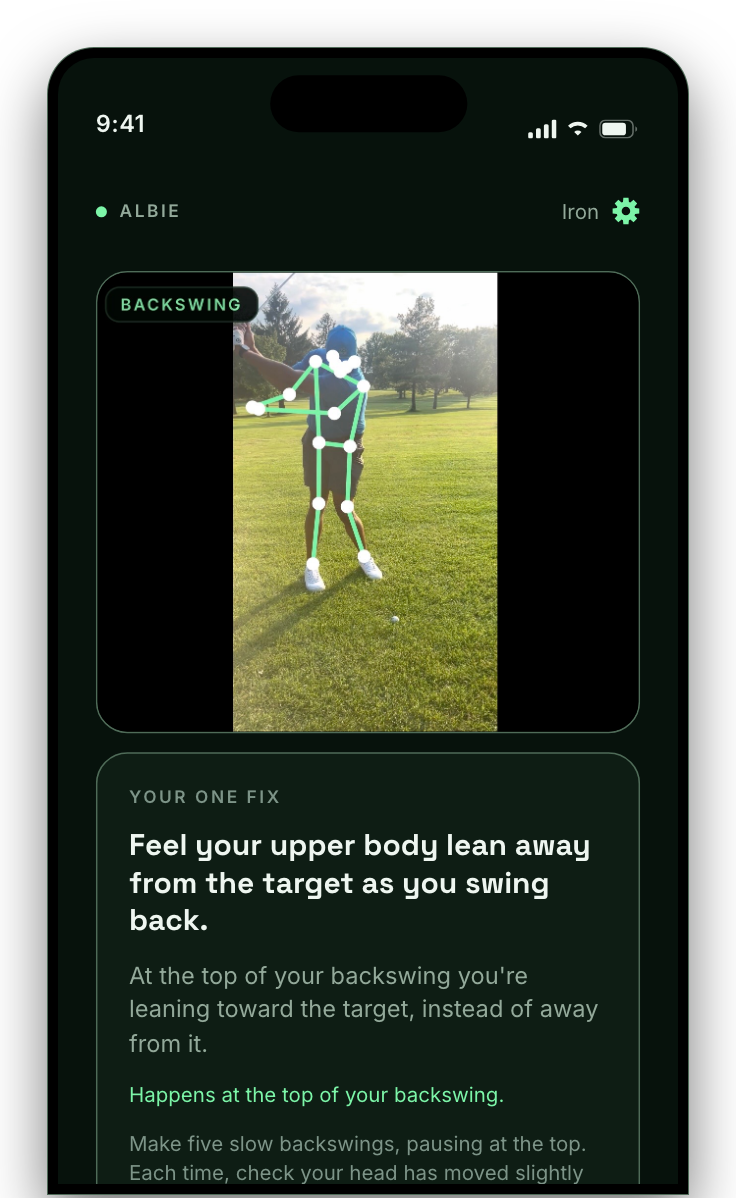
- Leaning toward the target at the top, instead of away from it
- A left arm that folds on the way back and shortens the swing
- Standing taller through the ball, instead of staying bent over it
- Hips pushing at the target through impact, instead of turning
- Shoulders dipping too far under the ball
- A hurried backswing with no time to change direction
You get one of them. The one that matters most, with something to feel and a drill to practice it.
Why one
One fix, not a wall of numbers.
Knowing your hips turned 38 degrees does not tell you what to do about it.
Most swing apps hand a beginner thirty measurements and leave them to work out which one matters. That is a dashboard. It is also how people end up practicing four things at once and getting worse at all of them.
Albie does the deciding. It measures everything, works out which fault is most likely holding the rest of the swing back, and gives you that one. Work on it, film another swing, and it tells you what is next.
Privacy
Your video never leaves your phone.
It is analyzed on the phone and deleted straight after. There is no account, no history, and nothing to sign up for.
Albie does send about thirty numbers from each swing, so the advice keeps improving on real golfers rather than on a handful. That part is anonymous, it is not linked to you, and you can switch it off in settings. The long version.
What Albie is not
Albie is a practice companion. It does not replace time with a PGA professional, and it will not pretend to be one. It reads one swing and gives you one thing to take into the next.
Questions
Before you ask.
Do I need a tripod?
Something that holds the phone still at about hip height, pointing straight at you. A tripod is easiest. A golf bag, a bench or a fence post works if the phone is not tilted down at you.
Do I need to be any good?
No. Albie is built for beginners, and the seven things it looks for are the ones that show up early. It names the side of your body in plain words, so there is no vocabulary to learn first.
Can I use it indoors, or into a net?
Yes, as long as you can stand back three or four steps and there is enough light to see you clearly. Albie never looks at the ball or where it went, only at you.
Does it work left-handed?
Yes. Albie asks once whether you swing right or left-handed, and every fix names the correct side of your body afterwards.
How is this different from an app full of stats?
The stats are the easy part. Deciding which one to act on is the product: Albie ranks what it finds and hands you a single change, in a sentence you can act on before the next ball.
What do I need to run it?
An iPhone on iOS 15 or later, or an Android phone on Android 9 or later. Something to stand it on, a few steps of space, and somewhere to swing.